In 2022, Al Khayma Heritage Restaurant opened inside a restored house in the Al Fahidi Historical District, steps away from Al Seef and the Creek, and gave the cuisine a permanent address in the oldest quarter of the city. The same year, the Michelin Guide arrived in Dubai and named Al Khayma a Bib Gourmand in its very first edition. It has held the distinction every year since: 2022, 2023, 2024 and 2025, the only Emirati restaurant in Dubai to do so. In 2025 it also received the Michelin Guide Dubai Service Award, given to just two restaurants in the city.
But the story, as the team tells it, does not begin with a restaurant menu. It begins with a day in an Emirati home.
Hospitality begins before the table
The door on the street is more than a hundred years old. In 2022 it read as a doorway in a wall: painted lettering, two benches, a lantern either side. Today an illuminated Arabic and English sign, the national flag and a traditional majlis set outside greet guests from the street, with the dallah ready.
Anyone walking through the district can stop for a cup of gahwa or Arabic tea, whether or not they ever sit at a table. It is offered freely, as a sign of generosity. "Before you become our customer, you are our guest," is how the house puts it – and the person pouring does not simply pour and walk away.
From the entrance, guests are invited into the majlis: cushions along three walls, a carpet, two low trays and a portrait of Sheikh Zayed. It is where people are received, where stories are exchanged, where a guest becomes part of the house. The intention is deliberate. Al Khayma is not trying to build a museum where people stand at a distance and look at Emirati culture. It wants them to sit inside it.
A courtyard where culture happens around you
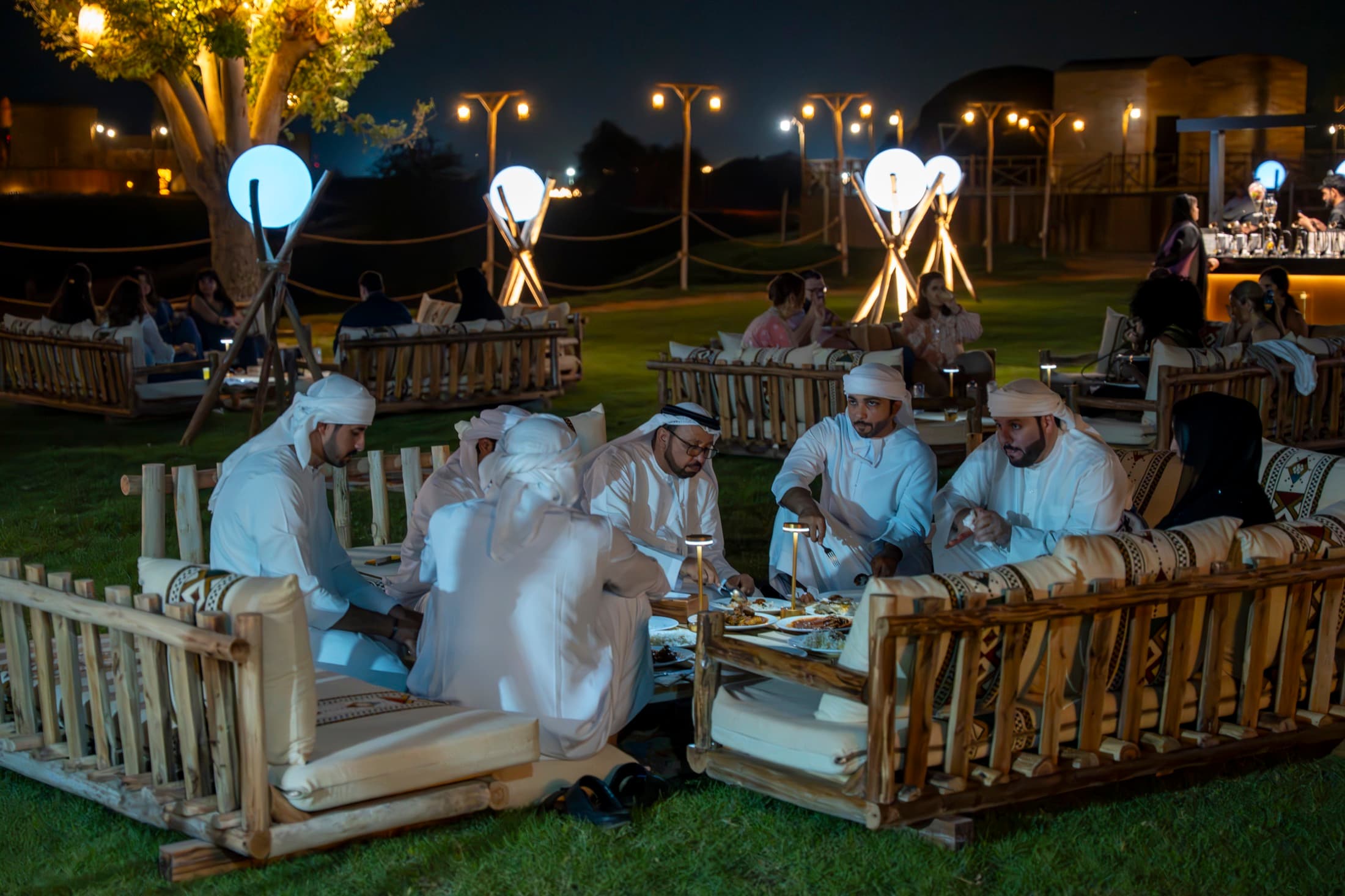
From the majlis, the house opens onto a covered courtyard with a tree at its centre, ringed by carved wooden furniture, low embroidered cushions and khoos, the palm-frond craft. Bread is baked in view of the tables, the team serves in traditional dress and live music runs through the evening. On performance nights, guests eat to the drums and chanted poetry of Al-Ayyala, inscribed on the UNESCO Representative List of the Intangible Cultural Heritage of Humanity, and Abu Tubaila. The culture is no longer something being explained to you. It is happening around you.
The menu came from 15 Emirati women
Food, the team says, is perhaps the easiest way to enter somebody else's culture. Breakfast (ريوق) is Balaleet. Lunch (غدا) is Emirati Machboos – Machboos, not biryani: rice, spices, saffron and dried lime, meat slow-cooked until it falls from the bone. Dinner (عشا) is Harees.
The menu was not invented in a restaurant kitchen. Al Khayma brought together 15 Emirati women – mothers and grandmothers – to shape it, carrying recipes and knowledge from the last two and three generations into the kitchen. Today the restaurant's Emirati chefs carry those recipes forward. When Machboos reaches the table, it is somebody's memory being served: a grandmother's way of seasoning, a mother's way of preparing the rice.
That is why service matters so much here. It is not only how quickly a plate arrives. It is noticing when a finjan is empty, waiting until the guest is ready, understanding the small signals. The 2025 Service Award, the team believes, recognised Emirati hospitality itself.
One product, three experiences
The house has grown into more than a restaurant. A guided Walking & Food Tour begins at Al Khayma and takes guests through Old Dubai, from learning about luqaimat and regag to tasting traditional flavours, with free walks to Bait Al Gahwa, Studio Zaman and Dukan Zaman. The Dubai Story Gallery, created with the UAE National Archives, follows the journey of Dubai and the founding of the UAE, from life in tents to reaching Mars. And Living Emirati Hospitality puts guests inside the culture: luqaimat prepared in front of them, gahwa poured from the dallah, traditions shared at the table.
Cooking classes, community events with Dubai's Community Development Authority, visits from top-achieving Dubai school students and participation in the Dubai Fitness Challenge 30x30 alongside Dubai Police extend the welcome beyond the dining room. The restaurant has hosted Google teams and the consuls general of the United States, China, Australia, Singapore, Germany, India and Egypt, and in 2025 was selected among the 10 restaurants on Dubai's inaugural Dianping Must-Eat List.
From a courtyard to the open desert
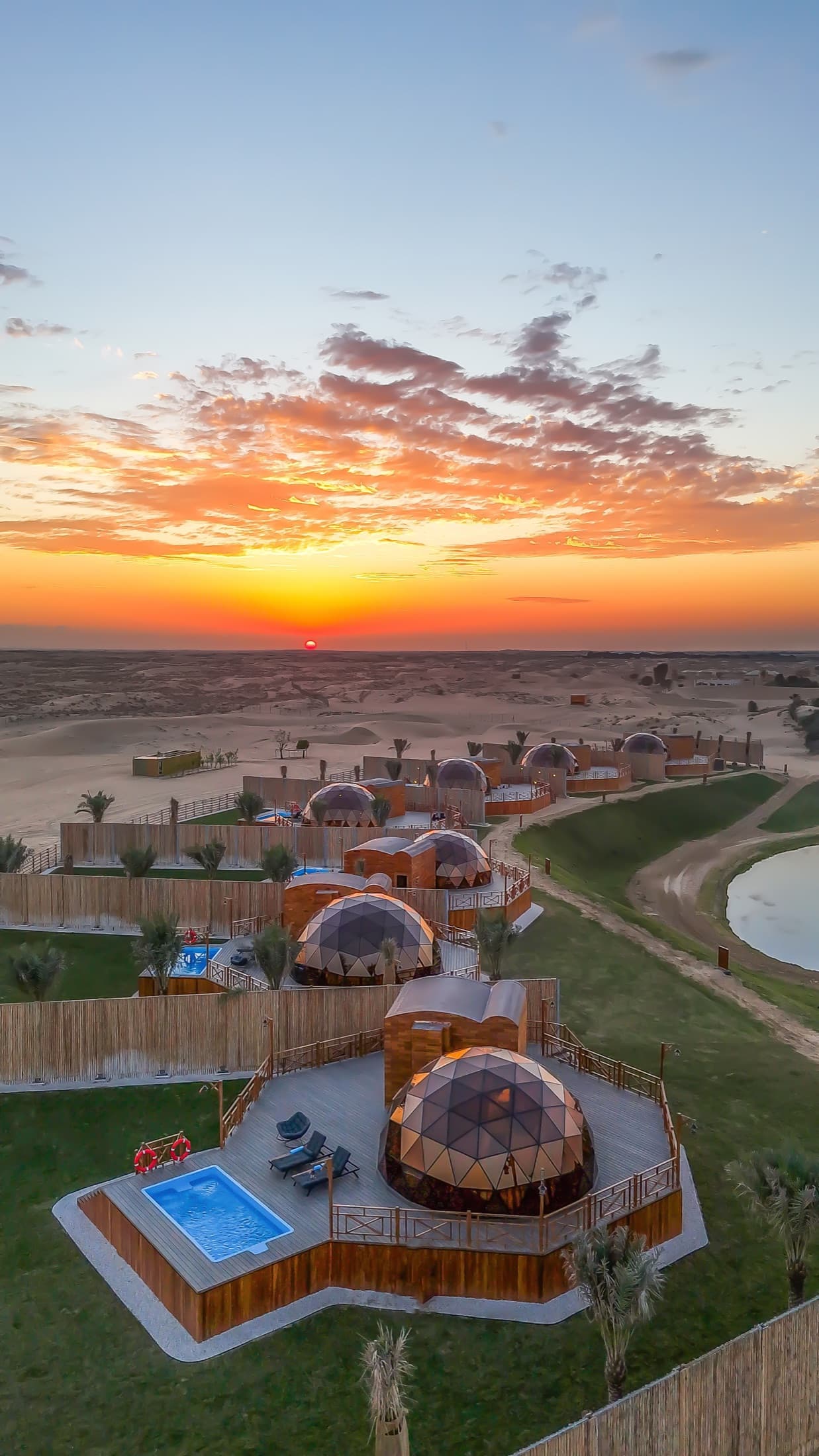
The concept has travelled without losing its identity. At Al Marmoom Oasis the same food is cooked on open sand, and the same story continues with the land: Al Khayma has its own farm, growing vegetables in protected desert greenhouses and raising Naimi sheep, so guests can see what is planted and increasingly eat from Al Marmoom itself. The plan is eight farmhouses across Al Marmoom and Al Khayma – two complete, six in development – alongside a farm-to-table model and a strengthened waste-management approach.
The footprint now runs from Al Fahidi to Al Marmoom, Souq Al Jami and Al Wathba, with Qasr Al Watan next and a dedicated Heritage Centre in development. The Sheikh Zayed Festival location has already taken the concept to a national audience in Abu Dhabi.
Three photographs of the same courtyard tell it best: open sky and a young tree in 2022; canopy and lighting in 2023; today, the tree grown into the roof and every table taken, with guests from every continent. The building did not lose its identity as it became successful. It became more alive.
"Food is Culture. Culture is Food," says Essam Al Salah, founder of Al Salah Holding, of which Al Khayma is part. The message to the visitor stays just as simple: come as a visitor, sit with us as a guest, leave with a story.